A Genetic Algorithm to Design Error Correcting Codes
(c) OPLINK::UNEX. Juan A. Gómez Pulido, 2005
I. Introduction
In some point-to-point communication systems the repetition of a corrupt message is not an objection, but yes in the real time communications, especially in multi-point communications. Thus, in telecommunication systems such as phone, television and digital radio, the information should be delivered with low delay, for which the use of an Error Correcting Code (ECC) is adequate to avoid overloads by transmitting. Many types of ECC exist. In this work we use the binary linear block codes, which are formed by a set of codewords, each of which is a binary string of the same length. The messages are composed by a sequence of codewords. When a message is transmitted, its binary string is sent through the physical environment building a flow of bits that can suffer modifications while crosses it. The error in a codeword is produced when a bit has changed along the way. In the receiver side would arrive an incorrect codeword.
For a given length of the codewords (n) and for a given number of codewords (M), the problem of finding an optimum code that corrects the maximum number of errors is NP-complete. The exact techniques can be useful for small instances, but for more realistic instances they are unfeasible by their high computational cost in time. By this reason, it should be used heuristics such as Genetic Algorithm (GA) [1], Simulated Annealing [2], Parallel Hybrid Heuristics [3], etc. In this work we undertake the problem with a GA.
II. Error Correcting Codes
The error correcting codes are characterized by the following parameters:
- The aridity of the code (q) represents the number of different symbols in the alphabet used in the code. The binary code, one of the most commonly used, has aridity 2 and uses the alphabet {0,1}.
- The length of a code (l) is the necessary number of letters (of the alphabet) to form a word (vector) in the code, where a code is a set of words (vectors) used to transmit a message.
- The size of a code (M) is the number of different words (vectors) in the code.
- The distance (d) from a code is the minimum Hamming distance between pairs of words (vectors) belonging to the code. The Hamming distance between two vectors x and y, denoted by d(x,y) is the number of positions in which the vectors x and y differ. In other words, the Hamming distance between x and y denotes the minimum number of operations of replacement that must be carried out to convert the x vector into the vector y.
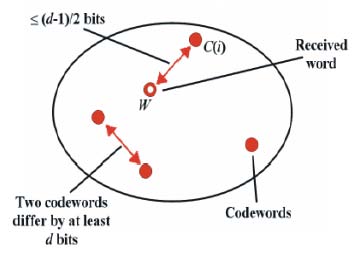
Fig. 1. Graphical interpretation of an error correcting system |
A C code can correct up to t errors if d(C) > (2t+1), where, d(C) = min{d(x,y)|x,y  C, x ? y}. The correction is obtained assigning to the incorrect string its nearest codeword in the destination. On the other hand, the Hamming distance between codewords must be highest to guarantee an optimum level of correction in the receiver, which suggests including high redundancy (longer codewords). What smaller is the codewords length, smaller is the minimum Hamming distance between them. So, as much as more separate are the codewords, more errors can be corrected. If all codewords are separated by d bits, then any modification of at most (d-1)/2 bits in a valid codeword can be corrected taking the nearest codeword (Fig. 1). C, x ? y}. The correction is obtained assigning to the incorrect string its nearest codeword in the destination. On the other hand, the Hamming distance between codewords must be highest to guarantee an optimum level of correction in the receiver, which suggests including high redundancy (longer codewords). What smaller is the codewords length, smaller is the minimum Hamming distance between them. So, as much as more separate are the codewords, more errors can be corrected. If all codewords are separated by d bits, then any modification of at most (d-1)/2 bits in a valid codeword can be corrected taking the nearest codeword (Fig. 1). |
A binary linear block code can be represented as a vector of three parameters (n, M, d), where n is the number of bits of every word of the code, M is the number of the codewords and d is the minimum Hamming distance between any pair of codewords C(i) and C(j) (i ? j). An optimum code is that one that maximizes d, for a given n and M. In this work we have chosen to solve the instance built for a code of 24 words and 12 bits (M= 24, n= 12) .Then, approximately 10 63 different codes are generated. Therefore, the exhaustive search is clearly discarded.
III. A Genetic Algorithm to Solve the Problem
The GAs imitate the way the nature selects the best individuals. We consider them by several reasons. GAs are used on optimization complex problems whose possible solution set is very high. There are not exact methodologies for finding the optimal solution, where conventional algorithms do not find good results [4][5][6]. The algorithm used, basically consist of an iterative three steps loop (a generation). Each step is characterized by a genetic operator: crossover, selection and mutation, that works (in this order) in each generation.
Representation. It has to be taken into account that the GA requires a good coding in a chromosome. Every chromosome can have several genes, which correspond with the parameters of the problem. To code the solutions of the problem we use a binary string of length M x n. Thus, in this problem each individual (chromosome) of the population is a binary code, represented by means of a M rows and n columns matrix. Every element of the matrix is a binary value (0 or 1) generated randomly.
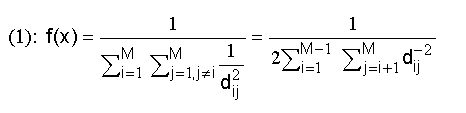
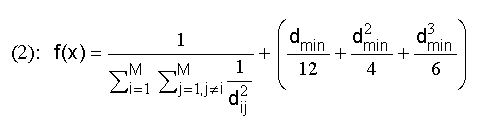
Fitness function. As fitness function to maximize, we would be able to use the minimum Hamming distance between the codewords. This function is not very useful, because it offers low level of information about the internal advantages of two solutions that compete. A more precise fitness function is the proposal by Dontas and De Jong [1], and shown in (1), where x is the code (vector of codewords) and d ij is the Hamming distance between xi and xj. This function has an objection: it can assign a higher value of fitness to a code with smaller minimum Hamming distance that another. To avoid this problem has been added to the equation a term that enlarges with regard to the minimum Hamming distance. Thus, the final fitness function that we have used is shown in (2), where d min is the minimum Hamming distance between codewords.
Genetic operators
- Selection. Selection specifies how the GA chooses parents for the next generation. We use a stochastic uniform strategy. Stochastic uniform lays out a line in which each parent corresponds to a section of the line of length proportional to its scaled value. The algorithm moves along the line in steps of equal size. At each step, the algorithm allocates a parent from the section it lands on. The first step is a uniform random number less than the step size.
- Mutation. Mutation specifies how the GA makes small random changes in the individuals in the population to create mutation children. Mutation provides genetic diversity and enables the GA to search a broader space. A piece (bit) of the matrix (code) is randomly selected. If this bit is 1, it is changed to 0 and vice versa. Then, new individuals are built.
- Crossover. Crossover specifies how the GA combines two individuals, or parents, to form a crossover child for the next generation. We interchange the parent rows in a random manner to build the sons.
II. References
- K. Dontas and K. De Jong, “Discovery of maximal Distance Codes Using Genetic Algorithms”, in Proceedings of the 2nd International IEEE Conference on Tools for Artificial Intelligence: IEEE Computer Society Press, 1990, pp. 905-811.
- A. A. El Gamal, L. A. Hemachandra, I. Shperling, and V. K. Wei, “Using Simulated Annealing to Design Good Codes”, IEEE Transactions of Information Theory, vol. it-33, no. 1, 1987.
- E. Alba and J.F. Chicano, “Solving the Error Correcting Code Problem with Parallel Hybrid Heuristics”, in Proceedings of the 2004 ACM Symposium on Applied Computing: ACM press, 2004, pp. 985 – 989.
- D. Goldberg, Genetic Algorithms in Search, Optimization, and Machine Learning, Addison-Wesley, 1989.
- M. Srinivas, “Genetic Algorithms: A survey”, Computer, 27 (26), pp. 17-26, 1994.
- C. R. Reeves and J. E. Rowe, Genetic Algorithms – Principles and perspectives - A guide to GA Theory, Kluwer Academic Publisher, 2003.